


Salar de Uyuni 3 Days 2 Nights
Description
Embark on an unforgettable journey through the Bolivian highlands with this 3-day, 2-night tour to the Salar de Uyuni, an experience that combines unique landscapes, colorful deserts, high-altitude lagoons, active volcanoes, and otherworldly natural formations.
During the tour, you will visit the Train Cemetery, the community of Colchani, the salt flats’ vents, the Dakar Monument, Incahuasi Island, Laguna Colorada, the Siloli Desert, and the majestic Licancabur Volcano, among other destinations.
About Uyuni
Located in the Department of Potosí, in the Plurinational State of Bolivia, Uyuni sits at 3,650 meters above sea level. With an area of more than 12,000 km², it is considered the largest salt desert in the world, an unmissable destination for nature and adventure lovers.
Itinerary
Uyuni Salt Flats Itinerary: 3 Days, 2 Nights
Day 1 – The White Desert and the Magic of Sunset
The tour begins with a visit to the Train Cemetery, one of Uyuni’s most iconic landmarks. Here you’ll see old locomotives and rusted train cars from the 20th century, remnants of Bolivia’s mining and railway boom.
Next, we visit the artisan community of Colchani, the gateway to the salt flats, where locals demonstrate the traditional process of salt extraction and refining, and offer handicrafts carved entirely from salt.
A few kilometers further on, we enter the Uyuni Salt Flats, the world’s largest salt desert, covering more than 10,000 km². Along the way, we visit the “eyes of water” (natural springs), the Salt Hotel (museum), the Dakar Monument, and the Plaza de las Banderas (Plaza of the Flags), a symbol of unity among travelers from around the world.
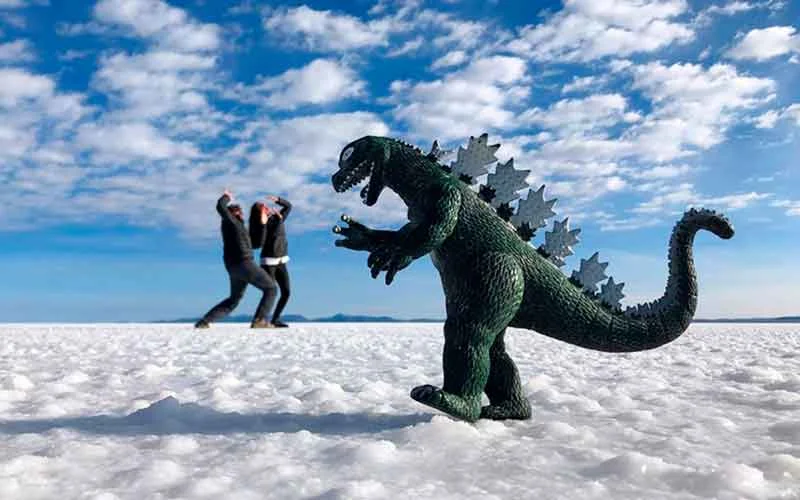
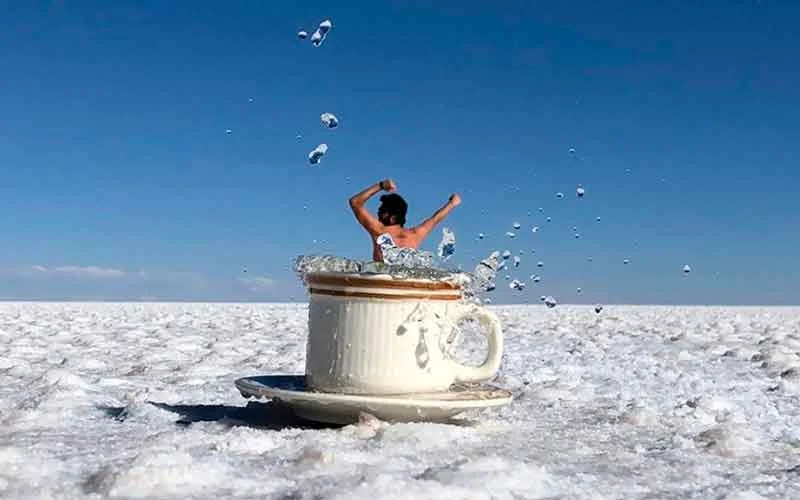
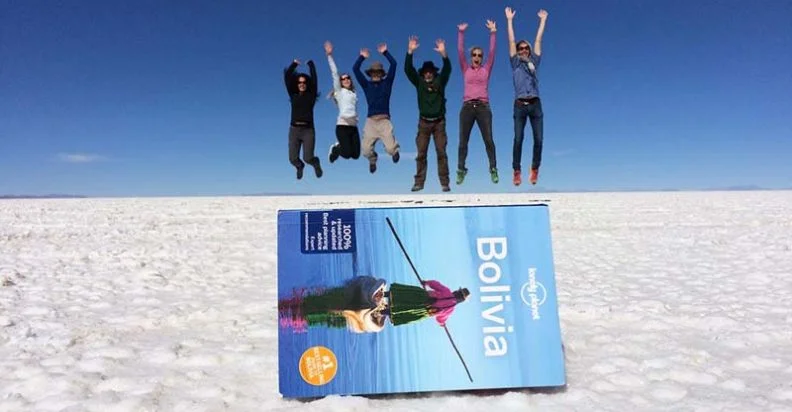
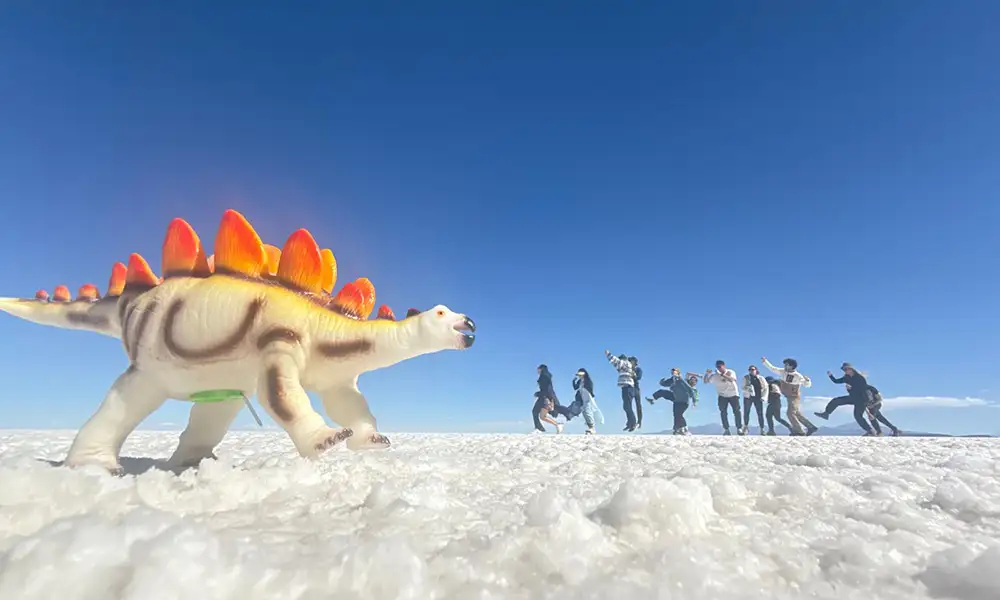
We enjoyed a typical lunch in the middle of the salt flats, surrounded by an endless white landscape, ideal for taking perspective and reflection photos.
During the dry season (April to November), we visited Incahuasi Island, a coral formation covered in giant cacti up to 10 meters tall. From its natural viewpoint, we enjoyed a 360° panoramic view of the salt flats.
During the rainy season (January to March), access to the island may be restricted, but we enjoyed the famous mirror effect, where the sky is perfectly reflected on the surface of the salt flats.
We ended the day witnessing an unforgettable sunset over the salt flats, with golden and pink hues painting the horizon. Dinner and overnight stay in a salt hotel, built with salt blocks, offering an authentic and cozy experience.
Day 2 – Altiplano Lagoons, Deserts, and Andean Flamingos
Approximate departure: 8:30 a.m.
After breakfast, we depart for the Salar de Chiguana, surrounded by the Andes Mountains and crossed by old railway lines. From this vantage point, we can see the Ollagüe Volcano, one of the few active volcanoes in Bolivia.
We continue to the high-altitude lagoons, located at over 4,000 meters above sea level:
- Laguna Cañapa: habitat of pink flamingos, with turquoise waters and saline shores.
- Laguna Hedionda: emerald in color and with a sulfurous scent, ideal for observing high-Andean birds.
Lunch approximately: 1:30 p.m.
Then we visit Laguna Honda and the Siloli Desert, known for its rock formations sculpted by the wind, including the iconic Stone Tree, a symbol of the Bolivian Altiplano.
The day concludes at the impressive Laguna Colorada, within the Eduardo Avaroa Andean Fauna National Reserve. Its red waters, the white of the borax, and the pink of the flamingos create one of the most striking landscapes in South America.
Approximate arrival: 6:30 p.m.
Dinner and overnight stay in a rustic community lodge.
Day 3 – Geysers, Hot Springs, and the Mirage of Licancabur Volcano
Approximate departure: 4:30 a.m.
We begin the day with a visit to the Sol de Mañana Geysers, an active geothermal field with fumaroles and boiling mud pools. The temperature can drop to -10°C, so appropriate clothing is recommended.
We continue to the Polques Hot Springs, where you can relax in natural outdoor pools, surrounded by mountains and a spectacular sunrise.
We then proceed to the Dalí Desert, a landscape of reddish sands and rock formations that evoke the surrealist works of the artist Salvador Dalí.
Later, we visited the Green and White Lagoons, located at the foot of the Licancabur Volcano (5,920 m.a.s.l.), on the border with Chile. These lagoons change color depending on the light and wind, offering an unparalleled natural spectacle.
Lunch approximately: 1:00 PM
On the way back to Uyuni, we stopped at the Valley of Rocks, a collection of rock formations sculpted by erosion, and in the town of San Cristóbal, known for its 17th-century colonial church, moved stone by stone from its original location.
Arrival in Uyuni: approximately 6:00 PM
End of services and farewell to the team.
INCLUDES
WHAT’S INCLUDED?
Pick-up and Transportation:
Transfer from your hotel or agreed-upon location in Uyuni. Transportation in comfortable and safe 4×4 vehicles (max. 6 people) for exploring the Altiplano.
Guide and Assistance:
Local Spanish-speaking driver-guide and personalized assistance throughout the tour.
Accommodation:
- 1 night in a salt hotel.
- 1 night in a rustic community lodge.
Meals:
Full board for 3 days (according to the itinerary). Balanced menus with local products. Vegetarian or special options available upon request.
Guided Tours:
Includes all the attractions on the itinerary: Train Cemetery, Colchani, Incahuasi Island*, Altiplano lagoons, Stone Tree, Laguna Colorada, Geysers, Polques Hot Springs, Dalí Desert, Valley of Rocks, and San Cristóbal.
*Available only during the dry season.
Entrance fees and permits:
Access to local communities such as Colchani, Valle de Rocas, and San Cristóbal is included.
Safety:
Each vehicle is equipped with a basic first-aid kit.
NOT INCLUDED
What’s not included?
Entrance to Eduardo Avaroa National Reserve
Bs. 150 per person (foreigners) or Bs. 30 (nationals). This fee is mandatory upon entering the reserve and grants access to Laguna Colorada, the Sol de Mañana Geysers, and Laguna Verde.
Entrance to Incahuasi Island
Approx. Bs. 30 per person. Payable in cash on site (dry season only).
Entrance to the Coquesa archaeological site
Approx. Bs. 15 per person. This is an optional visit managed by the local community.
Guide in English or other languages
This service is available at an additional cost and upon request.
Medical or travel insurance
Not included. It is recommended to purchase insurance that covers emergencies and altitude sickness.
Use of public restrooms
Available at some points along the route, managed by local communities (approx. Bs. 5 per use).
Additional drinks and snacks
Not included outside of the regular menu.
Transfers outside the Uyuni city area
Pick-up is only available from centrally located accommodations.
Towels, toiletries, and hot water
Some lodges do not have hot showers or towels.
Tips
Voluntary, not included in the tour price.
RECOMMENDATIONS
Recommendations for the traveler
Appropriate clothing: The climate in the highlands can drop to 10°C (50°F). Bring thermal underwear, a jacket, hat, scarf, gloves, and thick socks.
Dress in layers: Temperatures vary between day and night. Wear light layers underneath and a jacket on top.
Comfortable and waterproof footwear: The terrain can be wet or muddy, especially between January and March. Wear waterproof boots or shoes.
Sun protection: At over 3,600 meters (11,500 feet) above sea level, the sun is strong. Use sunscreen, UV sunglasses, and lip balm.
Stay hydrated: Drink water frequently and avoid alcohol or soda during your trip.
Cash: Carry between 250 and 300 Bolivianos for entrance fees, restrooms, souvenirs, or tips, as not all places accept cards.
Personal items: Include water, snacks, toilet paper, a towel, camera, extra batteries, and a portable charger.
Colorful clothing for photos: Vibrant colors stand out against the white backdrop of the salt flats and enhance your photos.
Altitude precautions: Avoid strenuous activity and consume coca leaves or coca candy if you feel unwell.
FAQs
Frequently Asked Questions
Where does the tour start and end?
The tour begins in Uyuni, with pick-up from your hotel or a pre-arranged location within the city. It also ends in Uyuni around 6:00 PM on the third day, with options to continue to Potosí, Sucre, or San Pedro de Atacama (Chile).
What time does the tour start and when does it return?
It departs at 10:30 a.m. on the first day and returns at 6:00 p.m. on the third day. Schedules may vary due to weather conditions or logistical issues.
What is the maximum altitude of the tour?
Between 3,600 and 5,000 meters above sea level, reaching the highest point at the Sol de Mañana Geysers (4,950 m). It is recommended to acclimatize in Uyuni or Potosí the day before.
What type of accommodation is included?
One night in a salt hotel and one night in a rustic community lodge with basic amenities. Some accommodations may not have hot showers or consistent electricity, so it is recommended to bring a flashlight and towel.
What type of meals are offered?
Full board is included for all three days (breakfast, lunch, and dinner). Typical Andean cuisine and vegetarian or special menus are available upon request.
How many people travel per vehicle?
Each group travels in a shared 4×4 vehicle (max. 6 passengers), accompanied by a driver-guide, ensuring comfort and ample space for luggage and cameras.
What is the best time to visit the Salar de Uyuni?
Dry season (April to November): You can visit Incahuasi Island and explore the entire salt flat.
Rainy season (January to March): The famous mirror effect is created, ideal for unique photographs.
Is it necessary to book in advance?
Yes, it is recommended to book 48–72 hours in advance, especially during peak season.
Can I continue on to San Pedro de Atacama (Chile)?
Yes, at the end of the tour you can arrange a direct transfer to Hito Cajón and continue on to San Pedro de Atacama. This service has an additional cost and must be requested at the time of booking.